Sample Post: Markdown, Code, Math, and Images
This post is a scratchpad demonstrating the building blocks available when writing on this blog. To start your own post, drop a new YYYY-MM-DD-slug.md into _posts/ and copy whatever frontmatter you need from the top of this file.
Markdown basics
Plain prose, italic, bold (note the accent color), and inline code all render as you’d expect. Hyperlinks like the Tokyo Night repo get their own accent and a hover state.
Premature optimization is the root of all evil (or at least most of it) in programming. — Donald Knuth
Bullets and numbered lists:
- Step one is to read the spec.
- Step two is to ignore the spec.
- Step three is to draft a postmortem.
- Reproduce the bug.
- Isolate the smallest failing case.
- Fix it; add a regression test.
Code blocks
Triple-backtick fences with a language hint get full syntax highlighting via Rouge. The colors come from the Tokyo Night palette baked into assets/css/jekyll-pygments-themes-native.css.
def fibonacci(n: int) -> list[int]:
    """Classic, iterative — O(n) time, O(1) extra space."""
    a, b = 0, 1
    out = []
    for _ in range(n):
        out.append(a)
        a, b = b, a + b
    return out


print(fibonacci(8))  # [0, 1, 1, 2, 3, 5, 8, 13]
fn dot(a: &[f64], b: &[f64]) -> f64 {
    a.iter().zip(b).map(|(x, y)| x * y).sum()
}
# Spin up the local Jekyll dev server
export PATH="/opt/homebrew/lib/ruby/gems/4.0.0/bin:/opt/homebrew/opt/ruby/bin:$PATH"
bundle install
bundle exec jekyll serve --livereload
Math (MathJax 3)
Inline math sits between $$ ... $$ inside a paragraph — for example, the Bellman equation \(V^\pi(s) = \mathbb{E}_\pi\!\left[ R_{t+1} + \gamma V^\pi(S_{t+1}) \mid S_t = s \right]\) is short enough to flow with prose.
Display math goes in its own paragraph:
\[J(\theta) \;=\; \mathbb{E}_{\tau \sim \pi_\theta}\!\left[ \sum_{t=0}^{T} \gamma^t r(s_t, a_t) \right]\]Numbered equations work via the LaTeX equation environment, and you can \eqref them later:
\begin{equation} \label{eq:policy-gradient} \nabla_\theta J(\theta) \;=\; \mathbb{E}{\tau \sim \pi\theta}!\left[ \sum_{t=0}^{T} \nabla_\theta \log \pi_\theta(a_t \mid s_t) \, \hat{A}_t \right] \end{equation}
The policy gradient theorem in equation \eqref{eq:policy-gradient} is the workhorse behind REINFORCE, A2C, PPO, and friends.
Images
The simplest form is plain Markdown:
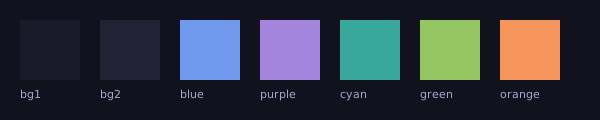
For richer behaviour — captions, click-to-zoom, responsive sizing — use al-folio’s figure.html include:

Side-by-side images use a Bootstrap row with col-sm for each cell:
<div class="row">
  <div class="col-sm mt-3 mt-md-0">
    {% include figure.html path="assets/img/posts/sample/palette.svg" class="img-fluid rounded" %}
  </div>
  <div class="col-sm mt-3 mt-md-0">
    {% include figure.html path="assets/img/posts/sample/palette.svg" class="img-fluid rounded" %}
  </div>
</div>
Tables
| Algorithm | On-/Off-policy | Action space | Notes |
|---|---|---|---|
| REINFORCE | on | discrete + continuous | High variance; use a baseline. |
| DQN | off | discrete | Replay buffer + target network. |
| PPO | on | discrete + continuous | Clipped surrogate objective. |
| SAC | off | continuous | Entropy-regularized actor-critic. |
Wrapping up
Once you’re comfortable with the format, delete this file and start populating _posts/ with the real stuff. Each post becomes a card on /blog/ and its own permalink at /blog/<year>/<slug>/.